Lorena is cooking for our small local Primaria this week. Monday was Flautas de Pollo .... 3 for 10 pesos. Earnings are partly for her and part for the school. She's using my stove rather than cooking on a wood fire. The bottom foto was mine and sadly the kids just get the basic Flauta.
Today she had help from another mom and her daughter making Salchipulpos (hot dog octopus). The foto is just an example and hers had no face. Too much work. Served in a bowl with crema and catsup. Both meals are meant to fill the kids up and not particularly healthy.
A neighbor fisherman brought home an octopus and it was decided to prepare it for dinner. We took it out to the washing station and she waited until I got my camera
First you take out the ink sack and the rest of the insides - then you start scrubbing. Lots of scrubbing and rinsing to remove the slime
Finally she removed the beak (boca) and a few small parts of the head
She boils it for an hour with garlic and onions and cuts it up in small chucks. This was fried in garlic butter, a little salt and worcestershire sauce. Veracruzana or diabla are other ways to cook it. Also makes good cevichi. Crisp tortillas, lime and jalapenos on the side
I've seen it around before but didn't think much of it until Lorena pointed one out as a medicinal herb and also one for cooking. My neighbor across the street has some and it tasted a little like mint to me and neighbors think it tastes like Vicks Vapor Rub (Va-pa-roo) which is eucalyptus.
For some reason all the neighbors know it as Palo Santo so my Internet searches turned up empty until today. There is an amazing amount of recipe pages, fotos and videos for it's many uses. Mostly wraps for cooking but but just cut up for flavoring as well. Not sure if I can take cuttings or if it spreads in the roots. I will go to a vivero (plant nursery) if I have to. Don't know what is in that wrap below but it sure looks good.
The video is the only one I found in English (many in Spanish) ... and the info below is from Wikipedia to fill in a bit.
Hoja santa (Piper auritum) is an aromatic herb with a heart-shaped, velvety leaf which grows in tropic Mesoamerica. The name hoja santa means "sacred leaf" in Spanish. It is also known as yerba santa, hierba santa, Mexican pepperleaf, acuyo, tlanepa, anisillo, root beer plant, and sacred pepper.
The leaves can reach up to 30 centimeters (12 in) or more in size. The complex flavor of hoja santa is not so easily described; it has been compared to eucalyptus, licorice, sassafras, anise, nutmeg, mint, tarragon, and black pepper. The flavor is stronger in the young stems and veins.
It is native to the Americas, from northern South America to Mexico, and is also cultivated in southeast Florida.
It is often used in Mexican cuisine for tamales, the fish or meat wrapped in fragrant leaves for cooking, and as an essential ingredient in mole verde, the green sauce originated in the Oaxaca region of Mexico. It is also chopped to flavor soups, such as pozole, and eggs. In Central Mexico, it is used to flavor chocolate drinks. In southeastern Mexico, a green liquor called Verdín is made from hoja santa. It is also used for tea. American cheesemaker Paula Lambert created "Hoja santa cheese", goat cheese wrapped with the hoja santa leaves and imbued with its flavor. While typically used fresh, it is also used in dried form, although drying removes much of the flavor and makes the leaf too brittle to be used as a wrapper.
The essential oils within the leaf are rich in safrole, a substance also found in sassafras, which has been shown to be carcinogenic in animals. In 1960, the U.S. Food and Drug Administration banned sassafras bark along with sassafras oil and safrole as flavoring agents because of their carcinogenic properties and the Council of Europe imposed the same ban in 1974, although toxicological studies show that humans do not process safrole into its carcinogenic metabolite.
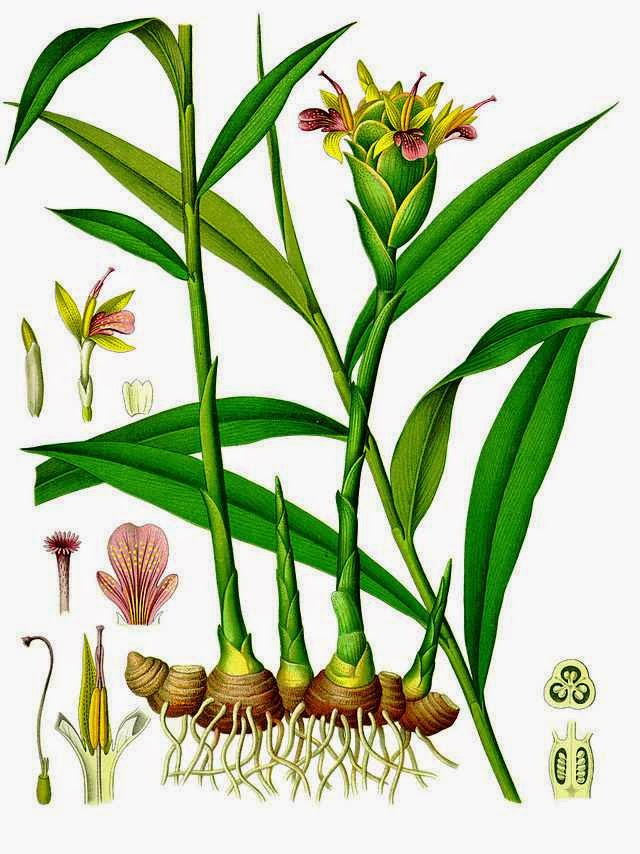
Not sure where I got the idea to try this except that the fresh Ginger (jengibre in Spanish) (hen-hebrey) I buy at Parisani has little "eyes" similar to potatoes. I had not read about the plant (annual or perennial), flowers or not, climate, soil, ornamental only or amount of sun.
Turns out it is a hardy plant that likes heat, humidity, water and fertilizer. I'll see how it does in the pot but it may end up in the garden because plants with rhizomes spread (put it where it can be controlled I read). Interesting to read about the history and origin of Ginger and how it got to the Americas. Haven't yet figured out the difference between common and ornamental. Ginger in Mexican cooking -- I heard in a certain Mole but nothing more. A continuing story I'm sure.
Tropical gingers, whether common or ornamental, require at least one year of undisturbed growth to bloom. Generally, the flower stems grow directly from a mature rhizome, although shell ginger's flowers grow directly from leaf stems. When growing new ginger plants from seeds or transplanted plantlets, they may require up to three years of growth before producing flowers. Planting ginger in a large, wide flowerpot and taking it indoors during winter gives the rhizome time to fully mature.
A few days ago my neighbor asked if she could use my oven (horno) and I assumed theirs didn't work or they didn't have one. Many people use just a cook-top and don't have a full stove. I told her sure but I haven't used it so unsure if it works (used stove).
Yesterday they wanted to bake a pastel or a cake .... and by her description it sounded like a sponge cake with a lot of other things thrown in.
They brought over a big metal pot covered with aluminium foil and I didn't really look inside. I asked if they knew at what temperature and for how long and I assume they guessed at 200 for 45 minutes. The oven did work and about an hour later they came back to check, decided it was good and time to pour the "agua" over it. The "agua" consisted of sugar, Jamaica (hibiscus), cinnamon and maybe more. Then back in the oven for another 20+ minutes.
When it came out and we tasted it I got a better description. Toasted bread, tortas or maybe even tortillas ... anything bread like. Fruit, raisins, coconut and nuts. The "agua" was to give it flavor beyond sweet and keep it moist. This morning I thought of "bread pudding", looked it up on the Internet and that's exactly what it was. Recipes call for a preheated oven at 350 ... but my oven only goes to 305. We must be on the metric system here and maybe 200 was correct. Anyway it was good, I got a big plate and they enough to feed a large family. Had to borrow the foto as my camera does not do well in low light.
About 5PM when people drift over to my stoop (sidewalk) because of the shade my house gives and setting up tables across the street for the nightly pozole ... another neighbor heads out on her nightly elote sales route. You can get elote (corn) on a stick or in a cup. Extras she offers are salt, limon, crema and a powdered chili. I prefer it in the cup and had to grab one tonight. She makes it very much like they do on the Cuernavaca Plaza where 6 or 8 stands set up every night.
Last night a neighbor brought over two of his wife's tortas de papas. I thought tortas were just the bread rolls but maybe they are anything to be filled? Basically they are a patty of mashed potatoes mixed with cheese, cilantro and whatever you want. Dipped in egg batter and flower and fried in oil. I looked on the Internet and didn't see any in sauce ... but they can be just about any size or shape.
I don't know how many Blog movies there are, maybe a few more, but Julie & Julia is a good one and a real story. What a deal to have your Blog project first turn into a book and then a movie.
Seems Julie is a bored government worker and a wanna be writer. She somehow comes upon Blogging as a project to express herself and stay busy. She can't Blog her daily life for fear of being discovered and loosing her job. Instead she decides to cook every recipe in Julia Child's book "Mastering the Art of French Cooking" and Blog it. That's 500 and some recipes in 365 day.
At this point the movie jumps back in time documenting Julia Child's entry into an all men's French cooking school in Paris. Julia goes from cooking school just to keep occupied to the notice that her famous book is being published and everything inbetween.
Julie's success starts with her Blog being mentioned in a New York Times article and goes from there. Two women that start at the beginning and end up with huge success. Cool movie and very well done.
The construction of the house finished in April 2011 and I'm pretty much settled in. As of March 2014 I'm in preparation for rain mode for this coming summer. That includes sealing and painting things and dealing with drainage issues from last year.